#context-management
-
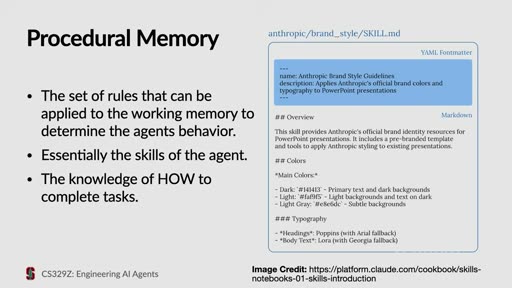
How AI Agent Memory Works: MemGPT & Memory Types | Stanford CS329Z Lecture 7 with Michael Ryan
Michael Ryan's lecture for Stanford CS329Z (Engineering AI Agents, recorded 14 October 2026) sorts agent memory into four types borrowed from the CoALA paper. Working memory is the context window, episodic memory holds raw logs of past trajectories and conversations, semantic memory holds facts about the user and the world, and procedural memory holds skills. Memory can live in the weights (parametric) or be retrieved into the context, and Ryan's rule of thumb is context for small sets of facts and fine-tuning or RL for skills.
-
Full Walkthrough: Workflow for AI Coding — Matt Pocock
Matt Pocock's 96-minute AI Engineer workshop (1.6M views): a complete idea-to-production workflow for AI coding, built on the thesis that 20-year-old software engineering fundamentals are what make agents work (Pragmatic Programmer, Fowler, Brooks, Ousterhout cited throughout; closing advice: "head to Amazon and just buy a ton of those old books").
-
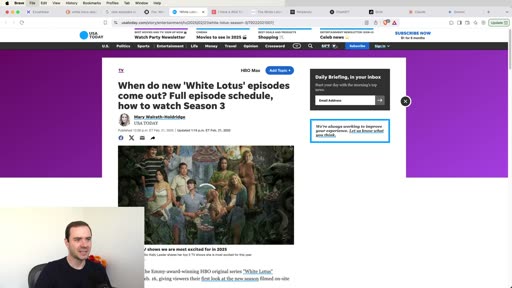
How I use LLMs
Karpathy's 2h11m general-audience sequel to Deep Dive into LLMs (2.7M views, Feb 2025): a hands-on tour of the LLM app ecosystem (ChatGPT as the feature-rich incumbent, plus Claude, Gemini, Grok, Perplexity, DeepSeek, Le Chat), organised by what goes into the context window.
-
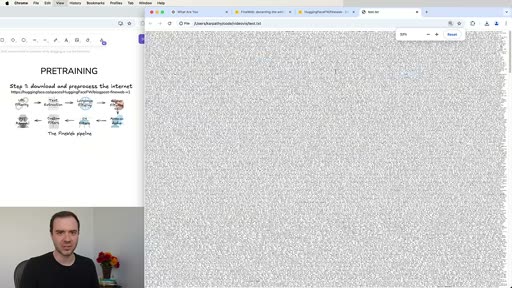
Deep Dive into LLMs like ChatGPT
Karpathy's 3.5-hour general-audience deep dive (9.7M views, Feb 2025) covers the full ChatGPT pipeline: pretraining (internet → tokens → next-token prediction), supervised fine-tuning (conversations → an assistant persona), and reinforcement learning (practice problems → emergent reasoning). Throughout, he maps the stages onto how children learn from textbooks: exposition, worked examples, practice problems.